
Menü öffnen Menü schließen

How to Choose a Badminton Ballmaschine in 2026?

Choosing a Badminton Ballmaschine in 2026 requires more than comparing prices and glossy product photos. Training technology is becoming more measurable, but product claims are not always equally reliable. The Badminton World Federation’s recent annual reports emphasize structured development, coach education, and accessible training environments. These priorities matter when selecting a machine for a club, academy, or serious home court.

Look closely.

The 2024 SFIA Topline Participation Report tracks badminton within the wider racquet-sports sector and reinforces a useful point: participation data cannot replace equipment testing. A popular machine may still deliver inconsistent feeds. Check its shuttle capacity, launch frequency, speed range, random oscillation, and usable battery time. A machine that holds 180 shuttles sounds practical, yet repeated loading can become frustrating during a two-hour session. Some models advertise high speeds without explaining shuttle type, angle, or measurement method. That deserves caution.

Real court experience remains valuable. Test whether the feeder sends shuttles cleanly from the rear court, midcourt, and service line. Listen for motor vibration. Observe the first ten shots, not only the best one. A reliable unit should support controlled drills, recovery practice, and progressive intensity without creating unsafe rebounds. Independent reviews, manufacturer specifications, warranty terms, and local service access should support your decision.

No machine is perfect.

This guide compares the details that influence long-term value in 2026. It also questions common assumptions, because the cheapest option may cost more through repairs, weak batteries, or limited programming. Choose measurable performance over impressive wording.
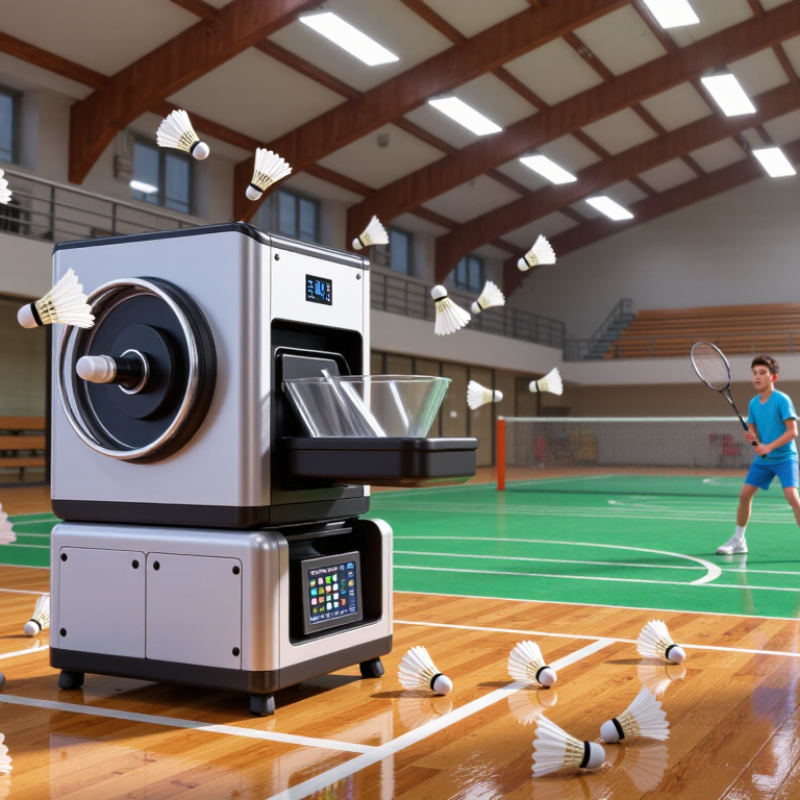
How to Choose a Badminton Ballmaschine in 2026?

What Is a Badminton Ball Machine and How Does It Work?

A badminton ball machine is a training device that feeds shuttlecocks without a human partner. Most models use rotating wheels, a spring arm, or a controlled launching tube. These parts grip and release each shuttle at a selected speed and angle. The machine may send shots straight, high, low, or across the court.

A control panel or remote usually adjusts feeding intervals, speed, elevation, and horizontal movement. Some machines create repeated clears, drives, drops, or smashes. An oscillating base can move the landing point from one side to another. This helps players practice footwork and recovery under pressure. The feed must remain consistent, but real shuttlecocks can behave differently. Feathers bend. Plastic shuttles travel faster or float longer.

When choosing a machine in 2026, check its adjustment range, shuttle capacity, battery life, and wheel protection. A stable frame matters on a polished court. Small wheels should not wobble during fast feeding. I have found that a quiet motor makes longer sessions less tiring. The stated speed is not always the speed you feel during play. Court distance, shuttle type, and humidity change the result.

Look for simple controls and clear safety instructions. The launching area should be easy to inspect before switching it on. A machine cannot read your posture or correct poor timing. I sometimes practice too many powerful shots and neglect defense. That is my mistake, not the machine’s. Use varied drills, watch the shuttle’s first bounce, and leave enough space around the feeder.

Which Training Features Should You Consider in 2026?

How to Choose a Badminton Ballmaschine in 2026?

Training features should match your actual practice, not a crowded specification sheet. The World Health Organization’s Global Status Report on Physical Activity 2022 estimates that 31% of adults do not meet recommended activity levels. A machine cannot replace coaching, but it can make every court minute more active.

Choose adjustable shuttle speed, launch frequency, elevation, and placement. A beginner may need gentle feeds every five seconds. An advanced player may require rapid, alternating shots with random angles. Randomization matters. Repeating one perfect pattern can create false confidence. Include programmable drills for clears, drops, drives, and defensive reactions. Interval controls also help you build sessions within the WHO recommendation of 150–300 weekly minutes of moderate activity.

Safety deserves equal attention. Look for obstacle detection, stable wheels, quiet operation, and a clear emergency stop. Battery duration should cover a full session, not just a showroom demonstration. Data logging can track shot count, drill time, and error patterns. Useful, but imperfect. Numbers cannot show whether your footwork collapsed under pressure. I would test the machine beside a real court, checking rebound consistency and setup time. Keep it simple. A reliable feed with thoughtful variation often beats an impressive menu of modes. SFIA’s 2024 participation report also highlights the value of measuring sports participation consistently, reminding buyers to judge equipment by regular use, not novelty.

How to Match a Ball Machine to Your Skill Level and Goals

How to Choose a Badminton Ballmaschine in 2026?

Match the machine to your current skill, not your ambition. Beginners need stable feeds, slower shuttle speeds, and wide placement zones. Start with control. A simple six-shuttle pattern can build timing without creating panic. The machine should offer adjustable intervals, elevation, and frequency. These settings help players repeat a clear overhead swing or defensive lift.

Intermediate players need variation. Choose a model with random horizontal placement, adjustable depth, and faster recovery between feeds. Advanced players should seek programmable drills, steep trajectories, and rapid alternating shots. BWF Laws of Badminton specify shuttle weights between 4.74 and 5.50 grams, so the feeder must handle regulation shuttles consistently. Poor feeding changes can hide technical mistakes. That matters.

Your goal also changes the decision. For footwork, prioritize movement width and unpredictable placement. For attacking practice, prioritize speed, height, and repeatability. For solo beginners, remote controls and simple setup may matter more than maximum capacity. The SFIA 2024 Topline Participation Report recorded about 5.8 million badminton participants in the United States during 2023, showing a broad market with very different training needs. More features do not automatically mean better progress. I once favored speed over precision, and the sessions became tiring rather than useful. Test the machine for ten minutes. Watch the shuttle land near your intended target. Then reconsider.

How to Choose a Badminton Ballmaschine in 2026? - How to Match a Ball Machine to Your Skill Level and Goals

Player Profile Main Training Goal Recommended Feed Rate Recommended Shuttle Capacity Useful Operating Features Preferred Shot Patterns Key Buying Considerations
Beginner Build a consistent contact point, basic footwork, and confidence with forehand and backhand strokes. Low to moderate: approximately 20–40 shuttles per minute About 80–120 shuttles
  • Simple speed and frequency controls
  • Easy start/stop operation
  • Stable base and clear control panel
Consistent high serves, gentle clears, straight drives, and predictable net feeds. Prioritize reliable feeding and simple setup over advanced programming. A moderate launch speed is easier to control and safer for learning technique.
Developing Intermediate Improve movement efficiency, stroke repetition, recovery, and the ability to sustain rallies. Moderate: approximately 30–60 shuttles per minute About 100–150 shuttles
  • Adjustable launch speed and elevation
  • Horizontal oscillation
  • Programmable or variable feed intervals
Alternating forehand and backhand drives, two-point footwork, mid-court drives, and repeated clears. Look for enough directional variation to prevent memorized movement. Adjustable intervals help develop timing instead of only reaction speed.
Advanced Club Player Train attacking transitions, defensive recovery, multi-shuttle intensity, and court coverage under pressure. Moderate to high: approximately 50–90 shuttles per minute About 120–200 shuttles
  • Independent horizontal and vertical oscillation
  • Wide speed and elevation range
  • Randomized or programmable sequences
  • Remote start/stop control
Six-point movement, alternating rear-court and front-court feeds, fast drives, defensive blocks, and attack-to-defense combinations. Check whether the machine can change direction quickly enough for realistic footwork. Stability, repeatability, and a sufficiently strong launch mechanism are more important than maximum capacity alone.
Tournament-Oriented Player Replicate demanding match situations, improve decision-making, and maintain technique at high fatigue levels. High and variable: approximately 60–100 shuttles per minute, depending on the drill About 150–250 shuttles
  • Detailed multi-step drill programming
  • Fast randomization and directional changes
  • Wide range of speed, angle, and frequency settings
  • Quick remote adjustments
Random full-court patterns, attack-defense transitions, late-reaction feeds, rapid drives, and mixed-depth sequences. A machine should support controlled unpredictability. Random feeds are useful only when the player can still maintain safe technique and recover correctly.
Singles-Focused Player Develop endurance, full-court movement, rear-court recovery, and depth control. Approximately 30–80 shuttles per minute About 100–200 shuttles
  • Long-range elevation adjustment
  • Full-court horizontal coverage
  • Programmable six-point and corner drills
Corner-to-corner clears, front-to-back movement, six-point patterns, and alternating deep and short feeds. Prioritize court coverage and accurate depth variation. A machine that feeds only to the middle of the court will not adequately train singles movement.
Doubles-Focused Player Improve reaction speed, flat exchanges, interception, defense, and front-back transitions. Approximately 50–100 shuttles per minute About 120–200 shuttles
  • Fast low-to-mid-height feeds
  • Rapid frequency adjustment
  • Wide horizontal oscillation
  • Short-distance random patterns
Flat drives, body attacks, side-to-side defense, front-court interceptions, and drive-to-lift combinations. Choose responsive feeding and stable low trajectories. Excessively high feeds may be less relevant for flat doubles exchanges.
Technique and Rehabilitation User Practice controlled repetitions while managing workload, fatigue, or a gradual return to play. Low: approximately 15–40 shuttles per minute About 60–120 shuttles
  • Fine speed and frequency adjustment
  • Low launch intensity
  • Clear emergency stop function
  • Easy height and angle control
Stationary forehand and backhand strokes, gentle net shots, controlled lifts, and low-impact movement patterns. The machine should allow gradual progression. Training intensity should be increased only when movement quality and physical tolerance remain comfortable.
Youth or Junior Player Develop coordination, timing, basic movement habits, and enjoyment through short structured sessions. Low to moderate: approximately 15–45 shuttles per minute About 60–120 shuttles
  • Simple controls
  • Stable, child-safe operation
  • Adjustable low launch speed
  • Short drill presets
Predictable feeds, basic forehand and backhand alternation, short movement drills, and target hitting. Select a model that can be supervised easily and adjusted to the player's height, strength, and attention span. Short, accurate drills are generally more useful than high volume.
Home User with Limited Space Practice consistently in a driveway, garage, backyard, or compact training area. Approximately 20–60 shuttles per minute About 80–150 shuttles
  • Compact footprint
  • Wheels or integrated carrying handles
  • Fast setup and storage
  • Adjustable feed distance and elevation
Short-court strokes, drives, net feeds, and reduced-distance footwork patterns. Measure the available space before buying. Allow extra room behind and beside the machine for safe operation, shuttle collection, and movement.
Frequent Club or Coaching Use Support repeated sessions, multiple players, structured drills, and efficient practice management. Variable: approximately 30–100 shuttles per minute About 150–250 shuttles
  • Durable construction
  • Large loading capacity
  • Repeatable programmable drills
  • Easy transport and maintenance access
Level-specific routines, multi-player rotation drills, footwork circuits, and progressive attack-defense sequences. Consider durability, replacement parts, battery or power options, transport weight, and ease of cleaning. Consistent output is essential when several players use the machine.

What Specifications Affect Performance, Portability, and Durability?

Choosing a badminton ball machine in 2026 requires more than checking its maximum speed. Performance depends on speed accuracy, feed interval, launch angle, spin control, and programmable placement. The BWF Laws of Badminton state that a correctly tested shuttle should land 530–990 millimetres before the opposite back boundary line. This gives buyers a useful court-based reference. A machine that launches fast but misses its target is not truly advanced.

Portability depends on weight, folded dimensions, wheel quality, handle design, and battery capacity. A 2024 SFIA participation report recorded roughly 4.8 million badminton players in the United States during 2023. That growth makes compact training equipment more valuable for clubs and home users. Still, advertised battery hours can be optimistic. Test performance under repeated feeding, not only standby conditions. Durability also depends on motor cooling, dust protection, frame rigidity, and replaceable parts. IEC 60529 ratings help describe enclosure protection, but an IP rating does not guarantee long-term mechanical reliability. My first checklist focused too heavily on speed. That was a mistake.

Tips: Choose adjustable feed intervals below five seconds for realistic rallies. Check whether the machine supports low, flat, and high trajectories. Compare net weight with the carrying distance. Ask for battery cycle data, service access, and warranty terms. If possible, observe fifty consecutive feeds. Uneven spacing usually reveals poor calibration. A quiet machine is helpful indoors, but silence should not replace stable shuttle delivery.

How to Compare Safety, Maintenance, Warranty, and Overall Value

Choosing a Badminton Ballmaschine in 2026 requires more than comparing launch speed or price. Safety should come first. Check for a reachable emergency stop, guarded moving parts, and a stable base that will not slide across a gym floor. Test the lowest setting before raising speed. A machine that launches unevenly can disrupt practice and create avoidable risks.

Maintenance affects long-term value. Look for clear cleaning instructions, accessible feeding wheels, and replaceable wear parts. Dust and broken shuttle feathers can collect around the launcher. After each session, wipe the feed channel and store the machine dry. I prefer simple controls, although I once underestimated how useful remote adjustment could be. That mistake made solo drills less efficient.

Tips: Compare warranty length, repair coverage, shipping responsibilities, and excluded parts. A longer warranty is not automatically better. Read the service conditions carefully. Ask whether support provides troubleshooting steps and realistic repair times. Calculate the total cost over three years, including replacement parts and transport. The cheapest option may become expensive if maintenance is difficult. Conversely, a premium machine may offer little extra value for casual players. Choose based on training frequency, court space, noise tolerance, and your willingness to perform basic upkeep.

How to Choose a Badminton Ball Machine in 2026?

A practical comparison framework for evaluating safety, maintenance, warranty support, and overall value without relying on brand names.

How to read the chart

The 100-point scorecard gives the greatest weight to safety because a ball machine uses moving wheels, high-speed feeds, and electrical components. Maintenance covers access to feed wheels, cleaning requirements, battery care, and the availability of replaceable parts. Warranty support reflects coverage length, service responsiveness, and repair arrangements. Overall value combines purchase cost, operating cost, durability, and useful features rather than focusing only on the lowest price.